Overview
Trigeminal neuralgia (try-JEM-ih-nul nu-RAL-juh) is a condition that causes intense pain similar to an electric shock on one side of the face. It affects the trigeminal nerve that carries signals from the face to the brain. This nerve has three branches and supplies feeling to the cheek, jaw, teeth, gums, lips, eyes and forehead. Even light touch from brushing your teeth or putting on makeup may trigger a jolt of pain. Trigeminal neuralgia can be long-lasting. It's known as a chronic pain condition.
People with trigeminal neuralgia may have short, mild episodes of pain at first. But the condition can get worse, causing longer periods of pain that happen more often. It's more common in women and people older than 50.
But trigeminal neuralgia, also known as tic douloureux, doesn't mean living a life of pain. Treatment usually can help manage the condition.
Products & Services
Symptoms
Branches of the trigeminal nerve
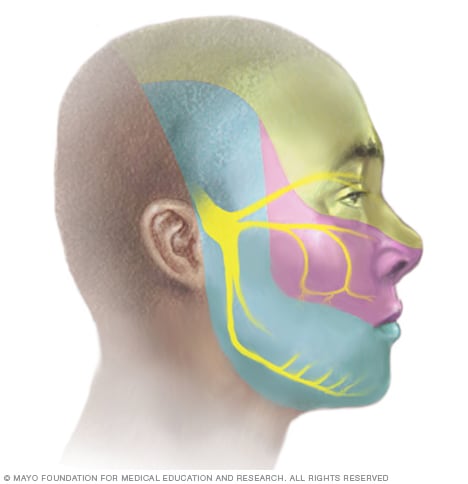
Branches of the trigeminal nerve
Trigeminal neuralgia results in pain occurring in an area of the face supplied by one or more of the three branches of the trigeminal nerve.
Pain of trigeminal neuralgia affects certain areas of the face. It is triggered by common activities and described in similar ways. These patterns include
- Episodes of intense shooting or jabbing pain that may feel like an electric shock.
- Pain in areas supplied by the trigeminal nerve. These areas include the cheek, jaw, teeth, gums or lips. Less often, the eyes and forehead may be affected.
- Sudden episodes of pain or pain triggered by touching the face, chewing, speaking or brushing your teeth.
- Pain on one side of the face at a time.
- Pain focused in one spot. Or the pain may be spread in a wider pattern.
The pain you feel may happen at certain times or last a certain length of time. These patterns may include:
- Episodes of pain lasting from a few seconds to several minutes.
- Pain that happens with facial spasms.
- Episodes of pain lasting days, weeks, months or longer. Some people have periods when they experience no pain.
- Pain that rarely occurs while sleeping.
- Episodes of pain that become more frequent and intense over time.
When to see a doctor
See your healthcare team if you experience intense jolts of pain in your face, especially if it's long-lasting or comes back after going away. Also get medical attention if you have ongoing pain that doesn't go away with nonprescription pain medicine.
Causes
Trigeminal neuralgia
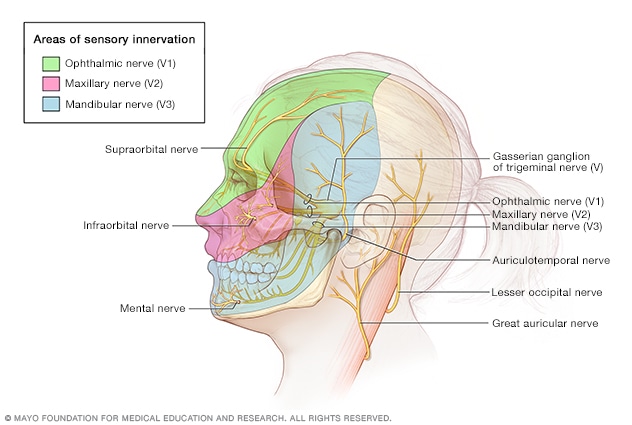
Trigeminal neuralgia
Trigeminal neuralgia is caused by a disruption in the trigeminal nerve's function.
In trigeminal neuralgia, the trigeminal nerve doesn't work as it should. This may happen for different reasons. There are three different types of trigeminal neuralgia: Classic, secondary and idiopathic. For each type, there may be a different cause of the pain.
In classic trigeminal neuralgia, a blood vessel at the base of the brain presses on the trigeminal nerve. The pressure interrupts the function of the nerve causing pain. The blood vessel may be an artery or a vein. This is the most common type of trigeminal neuralgia.
Secondary trigeminal neuralgia may be caused by underlying health conditions or issues. For instance, conditions such as multiple sclerosis (MS) damage the protective covering of certain nerves known as the myelin sheath. When the myelin sheath is damaged, pain may be felt. Also, injury to the nerve during surgery or a tumor pressing against the trigeminal nerve can cause the condition. Or some people may experience trigeminal neuralgia after a stroke or facial trauma.
Idiopathic trigeminal neuralgia may be diagnosed if there is no clear cause of the pain. This is the least common type of trigeminal neuralgia.
Triggers
Several triggers may set off the pain of trigeminal neuralgia, including:
- Shaving.
- Touching your face.
- Eating.
- Drinking.
- Brushing your teeth.
- Talking.
- Putting on makeup.
- A light breeze blowing over your face.
- Smiling.
- Washing your face.
Risk factors
Research has found that some factors put people at higher risk of trigeminal neuralgia, including:
- Sex assigned at birth. Women are more likely than men to experience trigeminal neuralgia.
- Age. Trigeminal neuralgia is more common among people age 50 and older.
- Certain conditions. Multiple sclerosis and hypertension are known risk factors for trigeminal neuralgia. Also, those who experience migraine headaches may have a higher risk of the condition.